For decades, Hollywood has treated cultural differences as a pesky problem to be solved rather than a creative advantage to be amplified and celebrated. Global audiences were once seen as something to translate for, flatten for, or cautiously include. The assumption was that stories rooted in specific cultural contexts would travel only so far, that universality required sanding down the sharp edges, and that anything too local would struggle to resonate at scale. Netflix blew up that logic. Not by accident, but by design.
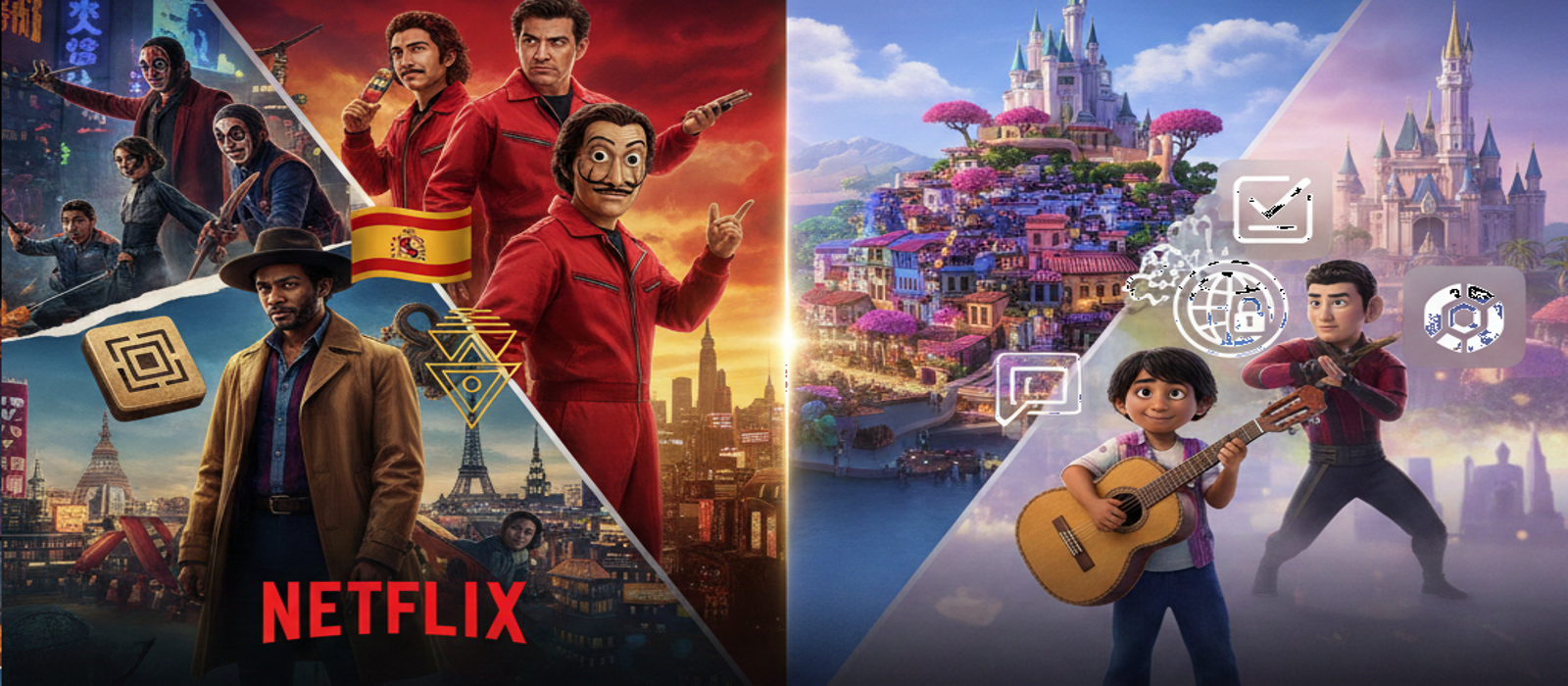
While legacy studios like Disney continue to frame multicultural storytelling through the lens of representation, inclusion, and cautious market testing, Netflix has quietly built a global entertainment engine fueled by specificity, cultural confidence, and trust in regional creative leadership. The results are not subtle. Squid Game did not become a global obsession because it was watered down for Western audiences. Money Heist did not cross language barriers because it tried to resemble American crime dramas. Lupin did not dominate international charts because it softened its “Frenchness”. These shows worked because they refused to dilute their cultural roots, choosing instead to lean all the way into them. And audiences loved them, anyway.
The difference between Netflix and Disney is not one of budget or reach. It’s more philosophical. Netflix treats culture as the narrative powerhouse it is. Disney still too often treats it as risk management and doesn’t want to dive too deeply, for fear of offending someone.
Disney’s modern multicultural strategy is built on an all-too-familiar corporate playbook. Representation is framed as progress. Diversity is positioned as innovation. Cultural inclusion becomes a branding exercise, carefully orchestrated to avoid backlash while still signaling virtue. Films like Black Panther, Encanto, Coco, and Shang-Chi represent meaningful steps forward in storytelling, yes. Still, they are also tightly engineered products, filtered to death through layers of corporate oversight, brand safety concerns, and global market sensitivities.
No matter how hard they try, the tension is always visible. How much culture is too much? How much authenticity might alienate mainstream audiences? How far can a story lean into specificity before it stops being “universal”? Netflix never asks these questions. Or more precisely, it does not let them shape creative decisions.
Instead, Netflix invests directly in local creative ecosystems, empowers regional showrunners, and builds distribution systems that allow stories to travel without being culturally diluted. Squid Game did not undergo Westernization before release. Its Korean social critique remained intact, from the economic anxiety to the moral ambiguity to the deeply Korean emotional throughline. Rather than rewriting it for broader palatability, Netflix trusted that emotional truth, visual storytelling, and narrative urgency would do the work. They trusted their audience’s intelligence and tolerance, and they were right.
Squid Game became Netflix’s most-watched series ever, topping charts in more than 90 countries and generating a global cultural moment that extended far beyond television. Halloween costumes, fashion collaborations, memes, academic analysis, and corporate think pieces all followed. But what truly mattered was not its popularity. It was the way the show reset executive assumptions about what global audiences are willing to engage.
Money Heist followed a similar trajectory. Originally a modest Spanish series, it gained global momentum once Netflix acquired and distributed it internationally. The show’s overt political symbolism, complex emotional arcs, and distinctly European pacing were left untouched. Rather than rewriting it to resemble American heist dramas, Netflix amplified its Spanish identity, allowing the characters, moral ambiguity, and anti-establishment tone to remain intact.
The result was not just viewership but devotion. Money Heist became a global fandom, spawning remakes, spin-offs, fashion trends, and political iconography. Its Salvador Dalí masks and red jumpsuits became international symbols of resistance. That simply does not happen when a story plays it safe.
Lupin did something equally powerful through a different lens. Rooted in French identity, class politics, and Black European experience, the series reimagined a classic literary figure through the perspective of a modern Senegalese-French protagonist. It did not overexplain race. It did not dilute cultural nuance for international viewers. It trusted its audience to follow. The show resonated across continents not because it felt familiar, but because it felt authentic. The current media environment is saturated with predictable storytelling; authenticity cuts through.
Disney, by contrast, continues to operate under a tired legacy framework where multicultural content is treated as a strategic exception rather than a creative norm. Stories about marginalized communities are often elevated as special initiatives, cultural moments, or milestone projects. They carry the weight of representation politics, brand scrutiny, and social expectation in ways that mainstream narratives do not. It had become a way to tick a box without genuine commitment to tell a wider variety of culturally resonant stories.
This creates a subtle but powerful constraint. When a story is positioned as symbolic, it becomes fragile. It must educate. It must inspire. It must avoid offense. It must represent entire communities rather than fully realized individuals. It must satisfy cultural consultants, marketing teams, shareholders, and global regulators, all at once.
The result is often beautiful but cautious storytelling. Encanto celebrates Colombian culture but filters it through Disney’s polished musical lens. Coco honors Mexican tradition but remains structured around familiar narrative formulas. Shang-Chi introduced martial arts spectacle and Asian representation into the Marvel universe, but still operated within rigid franchise architecture.
None of these films failed. Many succeeded spectacularly. But they did not fundamentally disrupt storytelling expectations. They expanded representation without dismantling the creative systems that constrain it.
Netflix does not operate inside that system. It does not rely on decades of brand mythology. It is not bound to a singular creative identity. It does not need to preserve nostalgic universality. Its competitive advantage is freedom. Freedom to take risks, freedom to trust local creators, and freedom to let culture lead. Freedom to lean all the way into cultural literacy.
That freedom allows Netflix to bet on stories like Sacred Games in India, Dark in Germany, Narcos in Colombia, Alice in Borderland in Japan, and Blood and Water in South Africa. These shows are not crafted to serve as surface-level cultural ambassadors to US audiences. They are built to entertain domestic audiences first. Global success is treated as a possibility, not a prerequisite.
This inversion matters. When creators write primarily for their own communities, storytelling sharpens. Characters become more layered. Emotional stakes deepen. Humor becomes more textured. Conflict becomes more honest. Cultural shorthand becomes richer, not thinner. Ironically, this makes stories more globally legible, not less. People will always be able to express themselves more efficiently in their native language, with their own culture front of mind.
Audiences today are far more culturally fluent than executives often assume. They navigate subtitles, international memes, and global fandom spaces effortlessly. They do not require cultural hand-holding. They crave immersion.
The global rise of K-dramas, anime, Afrobeats, Latin trap, and Nollywood cinema all point to the same conclusion. Culture travels best and penetrates deeper when it is not sanitized.
Disney still tends to approach culture as something to be translated for mass consumption. Netflix treats culture as something to be experienced. The implications for media executives are worth noting.
Global audiences no longer want content that feels designed by committee. They want stories that feel alive, rooted, and unafraid. They are drawn to narrative worlds that reflect lived realities rather than corporate ideals. They reward creative bravery with loyalty, advocacy, and sustained attention.
Netflix’s data-driven commissioning model supports this shift. By tracking regional performance, genre resonance, and audience behavior across markets, Netflix can invest in culturally specific content with greater confidence. But data alone does not explain their success. What truly differentiates Netflix is how it uses data to expand creative freedom rather than restrict it.
Where traditional studios often use audience insights to minimize risk, Netflix uses them to identify opportunity. It looks for cultural energy, not demographic safety. It seeks narrative hunger, not familiar formulas.
Disney, on the other hand, remains anchored to a worldview where global success requires narrative literacy, not cultural literacy. Stories must feel cohesive across continents. Tone must remain consistent. Brand must remain intact. Cultural experimentation is permitted, but only within carefully monitored boundaries. This approach protects legacy. It does not generate cultural momentum. The next era of entertainment will not be defined by who represents the most communities. It will be defined by who trusts them.
Netflix understands that cultural leadership does not come from inclusion campaigns. It comes from creative decentralization. It comes from building production ecosystems where storytellers have authority, not just access. It comes from letting stories remain strange, uncomfortable, joyous, messy, and specific.
Disney has the infrastructure, talent pool, and cultural capital to do the same. But doing so would require relinquishing some control, loosening brand rigidity, and embracing narrative risk. It would require shifting from representation as achievement to authenticity as strategy.
The success of Netflix’s global slate is not a fluke. It is a blueprint. One that signals where audiences are headed and what they increasingly expect.
Our media landscape is defined by algorithmic sameness and franchise saturation, and cultural specificity has become the ultimate differentiator. Stories rooted in real social contexts cut through because they feel human, even if unfamiliar at first. They remind viewers that entertainment is not just escapism. It is reflection, interrogation, and connection.
Netflix’s biggest hits succeed because they do not ask permission to exist. They arrive fully formed, culturally intact, and emotionally unapologetic. That is the future of global storytelling. And the companies that learn to trust culture rather than manage and sanitize it will be the ones shaping what the world watches next.